
Well not too much to say. I was practising with some polaroids that I completely messed up and as frustration I used normal HP5 and I still focused on the back eye 😀 shooting at f11. Obviously this one is not available on the print gallery, so hold your horses ladies.
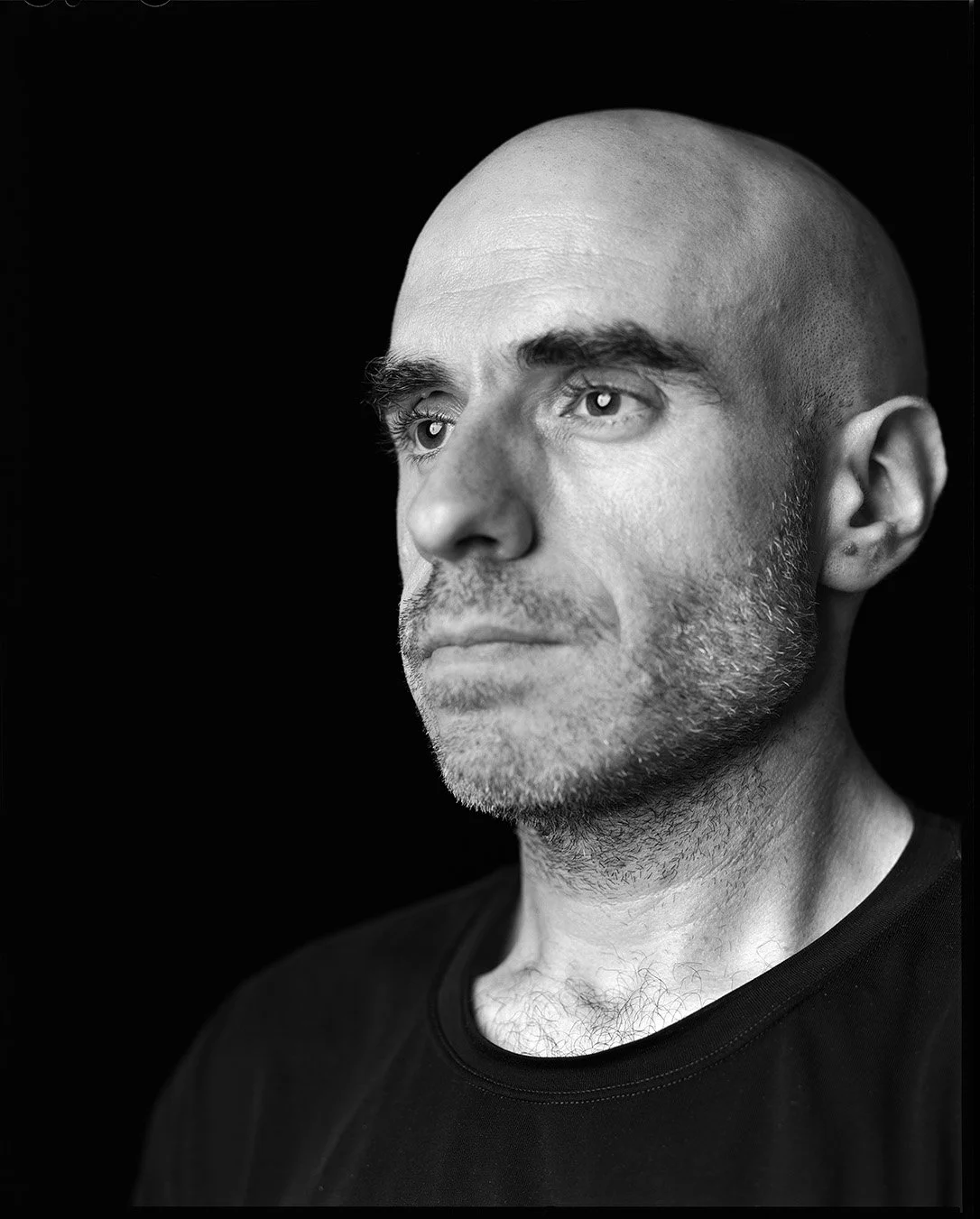
Shooting yourself on 8×10
This is a self portrait, and self portraits on a large format camera are genuinely hard to make. The problem is focus. On 8×10 the depth of field at portrait distance is thin enough that you cannot just aim at a spot and hope, you have to focus precisely on the plane your face will be in, and your face is not there while you are under the dark cloth looking at the ground glass. So you focus on a stand in, a chair, a mark, anything at the right distance, then get yourself into that exact spot without drifting forward or back, because a few centimetres is the difference between sharp eyes and soft ones.
The setup
This was on HP5 at f11, which is a wider aperture than I would use for a landscape, so the margin for error on focus was small. I got the back eye sharp, which is the one I care about, the eye furthest from the camera, because when that one is in focus the whole face reads as intentional. It started as frustration. I had been practising with some Polaroids that I completely messed up, and rather than waste the setup I loaded normal HP5 and made this instead. Some of the frames I am happiest with come out of exactly that, a plan that failed and a decision to keep shooting anyway.
Why bother
Turning the camera on yourself is a useful exercise even when the result is only for you. You feel what you put a sitter through, the stillness, the waiting, the single frame with no safety net, and it makes you a better guide the next time someone is on the other side of that ground glass. This one is not in the print gallery, so hold your horses. It lives here as a note to myself about focus, patience, and making something out of a session that started badly.
What it teaches
Turning the camera on yourself is one of the more useful things a portrait photographer can do. You feel exactly what you put a sitter through, the stillness, the waiting on a single frame with no safety net, the small vulnerability of holding your own expression while a stranger studies you through a lens. Do it once and you direct people differently afterward, with more patience and fewer demands. It also strips away every excuse. There is no one else to blame for a soft eye or a flat expression, just you, the ground glass, and a sheet of HP5 that will record precisely what you gave it. This frame stays here as a working note rather than a portfolio piece, a reminder that the fundamentals, focus, patience, and making something out of a bad start, are the same whether the face on the ground glass belongs to a client or to me.