
A problem during development that turned out to be a happy mistake
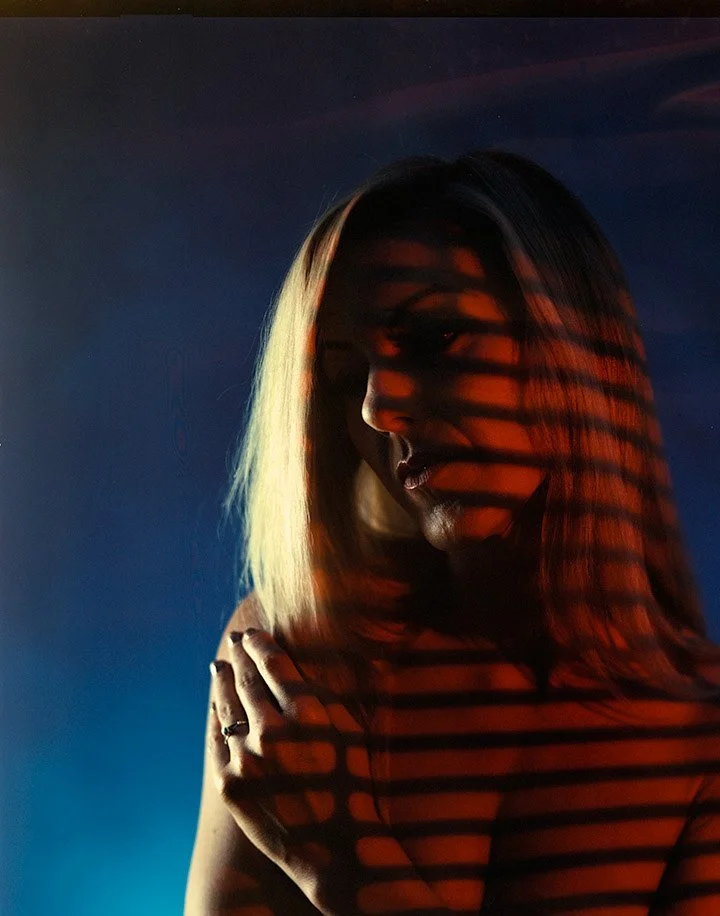
A happy mistake
This frame came out of a development problem that turned into something better than the clean version would have been. That happens with film in a way it does not with digital. A slip in the chemistry, a temperature that drifted, an uneven pour, and the sheet comes back with a character you did not plan and could not repeat if you tried. On a screen you would call it an error and delete it. On film you look at it for a while and sometimes decide the accident improved the picture.
Working in C41
This was processed in C41, the standard colour negative chemistry, which is less forgiving of drift than black and white developing. Temperatures are tighter and the steps are timed, so when something goes off, it goes off across the whole sheet in a way you can see. The shift it left on this frame is the whole reason I kept it. It gave the portrait a mood the correct version would not have had, and since every 8×10 sheet is a single unrepeatable object anyway, the flaw is not a copy of a flaw, it is the picture.
Why I do not fix everything
There is a temptation with any imperfect frame to correct it back to neutral, pull the colour straight, clean up the unevenness. I try to resist that. Film has a way of adding something when it misbehaves, and a portrait can carry a bit of chaos better than a landscape can. The trick is knowing which mistakes to keep. This is one I kept. Marie sat for it, and the development did the rest without asking me.
Why I shoot portraits on film at all
A frame like this is the argument for film in a single image. Digital would have given me a clean, correct, entirely predictable portrait, and there is nothing wrong with that, it is what I shoot for paying clients who need reliability. But film does things you do not ask it to. It reacts to temperature, to timing, to the age of the chemistry, and once in a while it hands back something with a mood the clean version would never have had. You cannot design that. You can only stay open to it and know which accidents to keep. For personal work, where the only client is me, that unpredictability is the entire point. I am not trying to control the outcome down to the last pixel, I am collaborating with a material that has opinions of its own, and Marie ended up in a portrait that neither of us planned and I would not trade for the correct one.
The part I keep coming back to is that this frame cannot be reproduced. A digital filter that mimics a development flaw can be applied to a thousand images identically. A real chemical accident happens once, on one sheet, and it is tied to the exact conditions of that day, the temperature, the timing, the pour. That is the difference between an effect and an event. This portrait of Marie is an event, and the only copy of the original is the negative sitting in my files, which is a strangely comforting thing in a field that usually deals in infinite identical copies.