
Second image of the Lighthouse Park at West Vancouver.
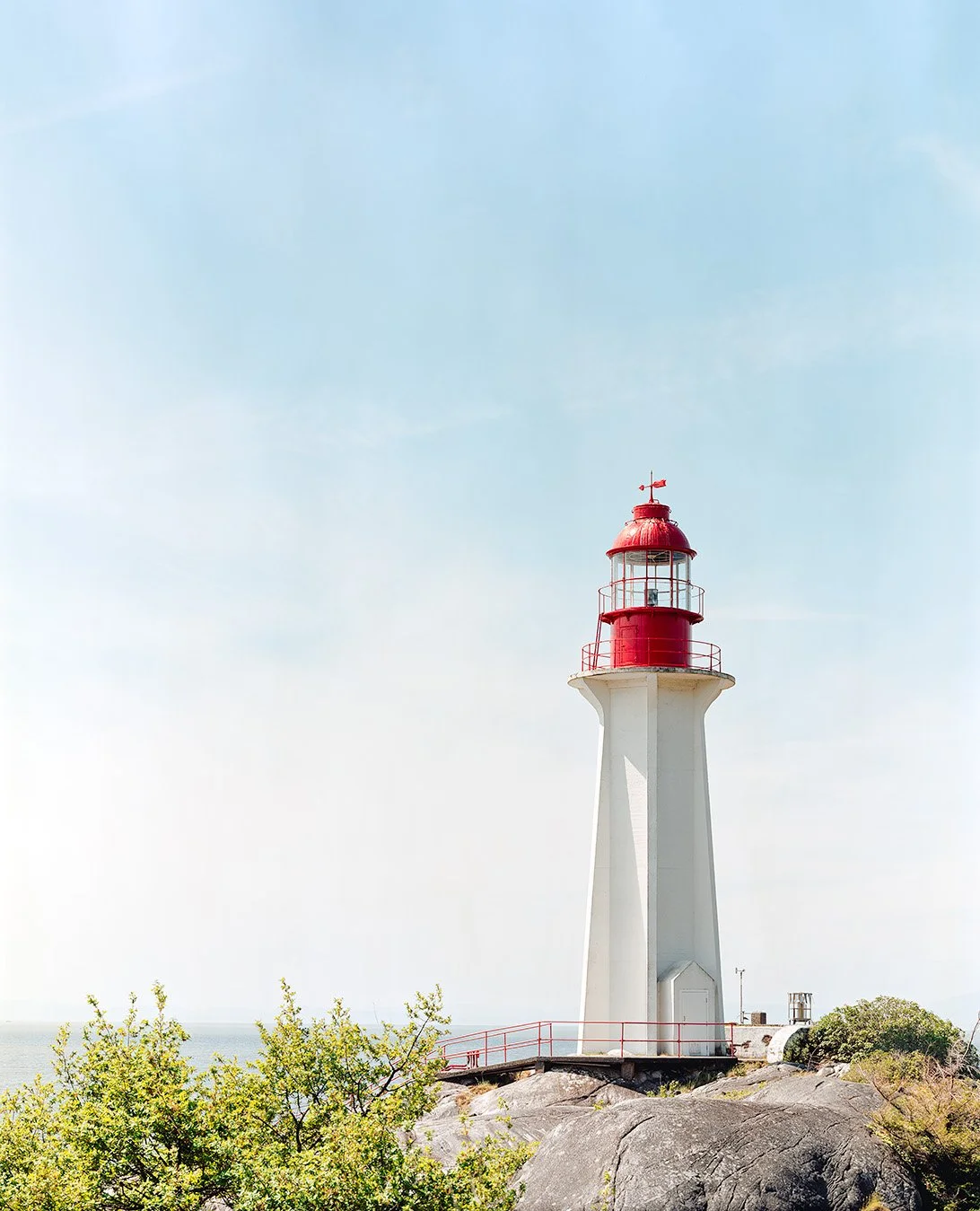
Camera: Gibellini AG810
Lens: Rodenstock 480 F9
Film: Kodak Portra 160
Developer: C41
Developed at: 160 ISO
Number of interruptions of people asking about the camera: 0
Exposure time: 1/8
Bellows Extension Factor: 0
Aperture: f/45
Digitized: SilverFast 9
Post Process: Photoshop
Lighthouse Park, West Vancouver
Lighthouse Park sits on the north side of the entrance to Burrard Inlet, and it is one of the last pieces of coastal old growth close to the city. Douglas fir that never got logged, granite bluffs dropping straight into the water, and the Point Atkinson light out at the tip marking the way into the harbour. You park at the top and walk down through the forest to the rocks, which is part of why the trees still look the way they do, the awkward access kept the loggers out. Some of the firs in here are among the largest standing that close to Vancouver.
The light itself has been working this point since 1875, and the six sided concrete tower that stands now went up around 1912. It still marks the turn for ships coming in off the Strait of Georgia toward the harbour, and it is a National Historic Site, so the point is protected as much for the light as for the forest behind it.
Shooting the coast on 8×10
This frame was made on a Gibellini AG810 with a Rodenstock 480mm, which is a long lens on 8×10 and lets me lift a distant section of shoreline out of the wider view. The film was Kodak Portra 160 in C41 at box speed, so the colour stays calm and the highlights on the water hold instead of blowing out. At f/45 the whole scene from the near rock to the far trees stays sharp, and that small aperture is why the shutter ran to an eighth of a second even in daylight.
The trade with a camera this size on the coast is weight against patience. You carry a heavy field camera, a tripod that can hold it, and a bag of film holders out to the bluffs, then you set up once and work the light instead of chasing it. Point Atkinson gets wind straight off the water, so a slow shutter means waiting for the surface and the branches to settle between gusts. By the time a single sheet is exposed you have stood with the scene longer than most people ever do. The full camera and exposure notes are above, and this frame is in the 2023 print gallery.
A word on the lens. A 480mm is a long lens even on 8×10, roughly what a short telephoto feels like on a small camera, and it has a big enough image circle to cover the sheet with room to spare for movements. On a coast scene that length is deliberate. It lets me isolate one band of shoreline and compress the distance between the near rocks and the far point, so the frame reads as a considered slice of the place rather than a wide grab of everything in front of me.