
Brockton Point
The Brockton Point light stands on the easternmost tip of Stanley Park, where the seawall turns and Burrard Inlet opens toward the harbour. The current structure dates to 1914 and replaced an earlier light that had marked the point since around 1890, back when the harbour was becoming one of the busiest working ports on the coast. It is a small, sturdy thing rather than a tall tower, built to sit low on the rocks and mark the turn for ships coming into the inlet.
A working landmark
What I like about Brockton Point is that it is not decorative. It was put there to do a job, keep vessels off the point and guide them into the harbour, and it still reads that way, plain and purposeful against the water. Behind it the freighters sit at anchor in the inlet and the North Shore mountains close off the far side, so a single frame can hold the light, the working harbour it serves, and the landscape all at once.
Why it works on 8×10
A subject like this rewards the discipline of a view camera. The light itself is small in the frame, so the picture depends on placing it precisely against the harbour and the mountains behind, and that kind of careful composition is exactly what focusing on a big ground glass is good for. You see the whole frame at once, upside down, and you can nudge the camera a few degrees to set the light exactly where it belongs relative to everything else.
Reading the light and the tide
Being on the east side of the park, the point catches morning light coming up the inlet, which rakes across the rocks and the structure and gives them some form. The tide matters too, since a lower water line opens up more foreground rock to build the composition on. So the frame is a matter of timing as much as position, being there when the light and the water and the harbour traffic all sit right.
An old process for an old marker
There is something fitting about photographing a hundred year old harbour light with a large format camera. Both belong to an earlier, slower idea of how a job gets done, deliberate, built to last, and unconcerned with speed. The negative will outlast most of my digital files, which feels right for a subject that has already outlasted the era it was built for and still stands doing its quiet work at the edge of the park.
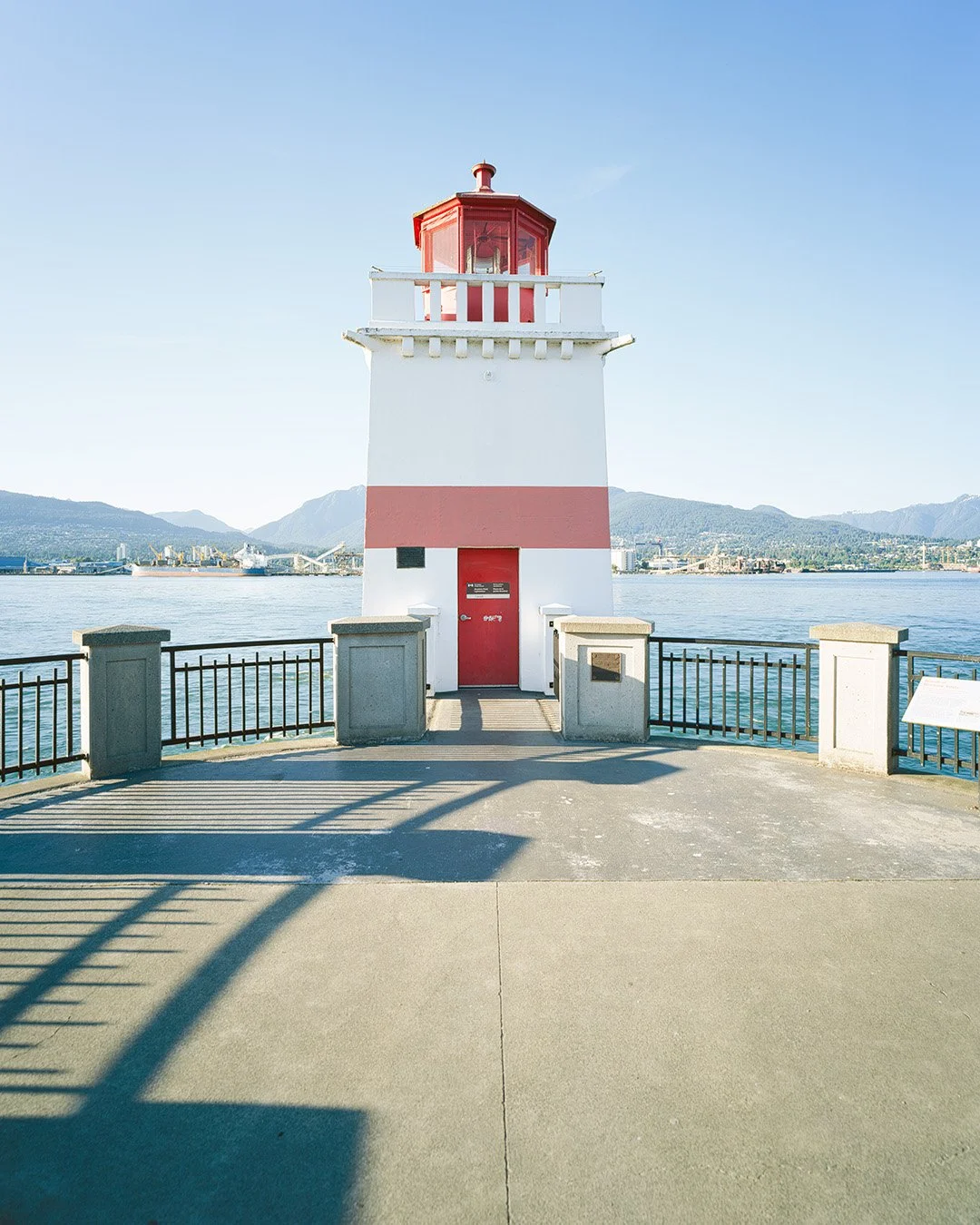
The setting is half the picture. Brockton Point looks straight out at the working harbour, where freighters ride at anchor waiting for a berth and the North Shore mountains close off the far side of the inlet. So the light is never alone in the frame, it sits in front of a genuinely busy stretch of water with real ships on it, which is exactly what it was built to serve. That context is what makes the small structure worth a sheet. It is not a decoration, it is a functional part of a port that is still very much alive, and the photograph is really about that relationship.