The dome across the water
Science World sits at the east end of False Creek, and its geodesic dome is one of the few buildings in Vancouver you can name from a single curved line on the skyline. It was built as the Expo Centre for Expo 86, designed by Bruno Freschi, who was the chief architect for the whole fair, and it opened in 1985 ahead of the world exposition that reshaped that side of the city. When the fair ended the building stayed and became a science museum, which is what it has been ever since.
Why the shape is worth a sheet
A sphere is a satisfying subject for a large format camera. There are no straight lines to keep vertical, so the usual architectural problem disappears, and instead you are working with one clean geometric form against the sky and its own reflection in the water. From across False Creek the dome sits above its mirror image on the surface, and on a still evening the two halves close into something near a full circle. That is the frame I was after, and it is the kind of composition that rewards a camera you cannot rush.
Shooting across the creek
The technical problem is distance and stillness. Working from the far side of the water means a longer lens and a locked tripod, and if I want the reflection clean I need the surface calm, which usually means early or late when the wind drops and the boat traffic thins out. Water that looks still to the eye is rarely still enough for a mirror, so a slightly longer exposure helps, letting the small ripples average out into a smoother surface on the film.
Light on a curved surface
A dome also does something a flat facade cannot. Because the surface curves away in every direction, the light wraps around it into a continuous gradient from the lit side into shadow, with no hard edge anywhere. A big negative renders that gradient without breaking it into steps, holding the subtle tones across the curve that a smaller format tends to compress. At dusk, with the sky going from warm to blue behind it, the whole dome picks up that colour across its skin.
The slow way, on purpose
None of this is quick. Set the camera, focus under the dark cloth on an upside down image, meter the sky against the shadowed side of the dome, load a sheet, and wait for the water and the light to line up. By the time I trip the shutter I have stood on that shoreline long enough to watch the scene change, which is usually when the frame I actually want finally arrives. The building is a monument to a particular moment in the city’s history, and photographing it with a process from an older era felt like the right pace for it.
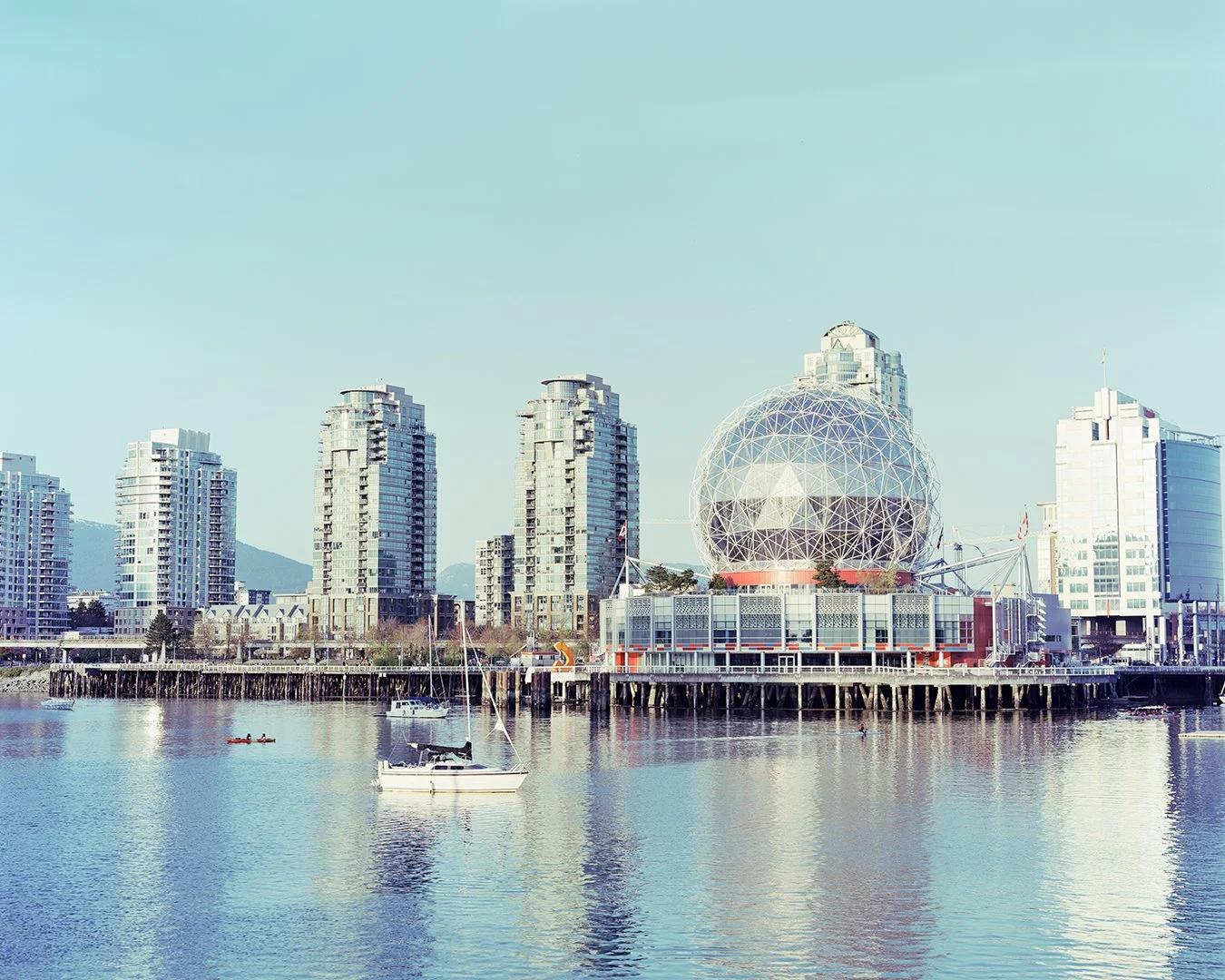
These days the dome is wrapped in programmable lights that put on a show after dark, which is its own kind of photograph for another night. I was after the daytime version, the bare geometry of the structure and its reflection, because that is the shape Bruno Freschi actually designed, before the light show was added on top. There is a whole side of the city that exists because of Expo 86, and the dome is the piece of it that everyone still recognises, so it felt worth recording plainly, as a building, rather than as a backdrop for coloured lights.