
Black and white 8×10 of Marie. I believe it was Delta 100.
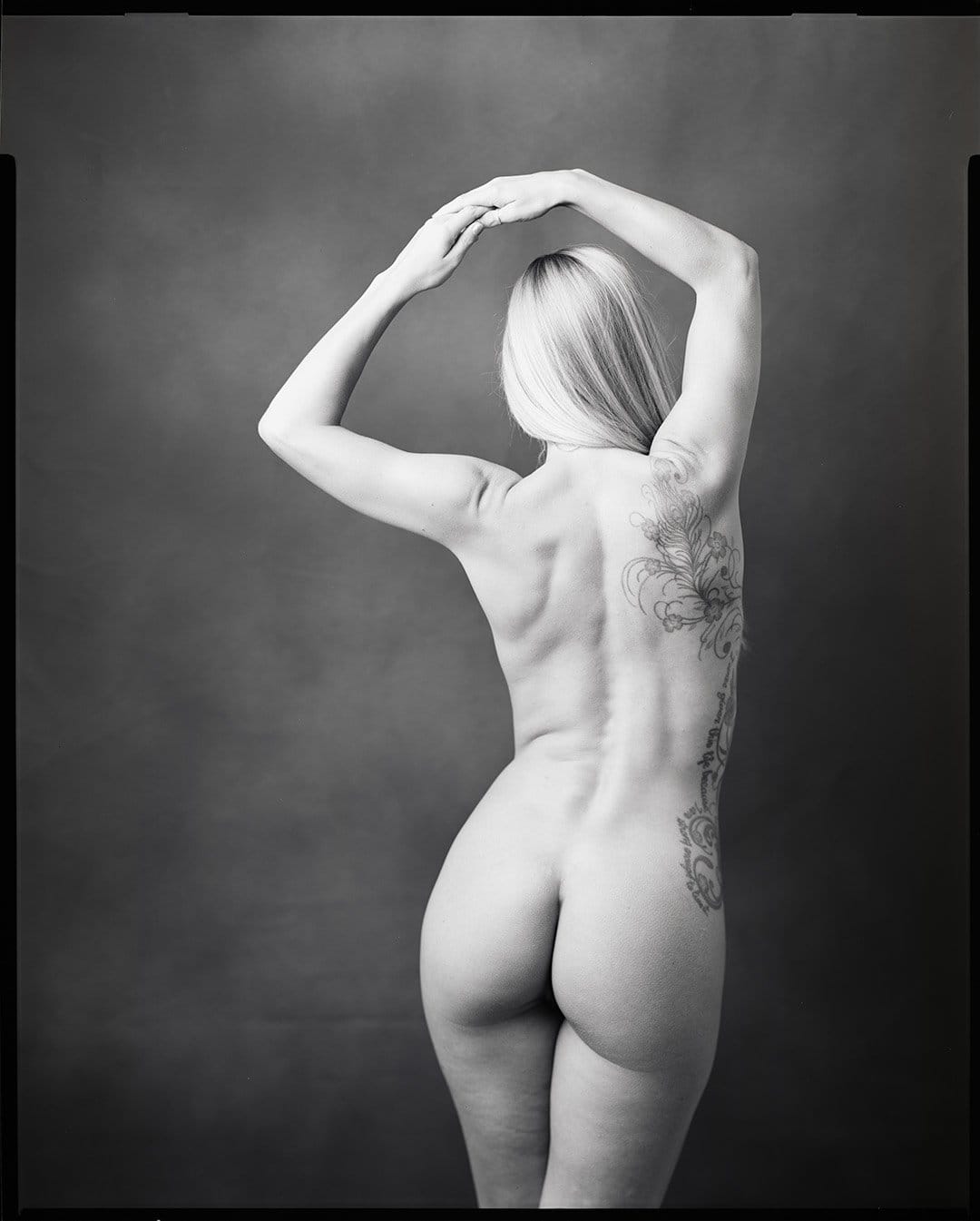
Black and white on 8×10
This one was black and white, and I am fairly sure it was Ilford Delta 100. Black and white large format is where the format earns its reputation. Strip out colour and a portrait comes down to tone and texture, the gradation from a lit cheek into shadow, the exact rendering of skin and hair and fabric, and an 8×10 negative holds all of that with a smoothness that is hard to describe until you have seen a contact print off one. Delta 100 is a fine grained, modern emulsion, so it keeps the tones clean and the grain almost invisible at this size, which suits a face.
Why the size matters for a face
Grain is a function of enlargement. A small negative blown up to print size shows its structure. An 8×10 negative barely needs enlarging at all, so the tones stay continuous and the skin reads as skin rather than as a pattern of grain. At portrait distance the depth of field is razor thin, so I focus on the near eye and let the rest fall away, and in black and white that fall off reads as pure tone with nothing to distract from it.
The process behind it
None of this is fast. I focus under the dark cloth on an upside down image, meter the face carefully because black and white gives you room to place the tones but punishes a careless reading, load a single sheet, and expose. Then it goes into the chemistry to be developed by hand. By the time the negative is dry I have spent more time on one frame than most sessions spend on a hundred. That is the trade, and for a black and white portrait on this scale it is worth it. Marie sat for this frame.
From negative to print
The other reason to shoot black and white this big is what happens after. An 8×10 negative can be contact printed, laid straight onto the paper at the same size with no enlarger in between, and a contact print off a sheet this large has a tonal quality that an enlarged print cannot equal. Every bit of the detail the lens resolved lands on the paper directly. For a portrait that means skin that holds its gradation from highlight to shadow without breaking up, and a sharpness in the eyes that feels almost uncomfortable to look at. It is a slow, hands on process, developing the negative, then working the print under safelight, but the result is a physical black and white photograph with a presence that scanning and screens flatten out. This frame of Marie was made with that whole chain in mind, film chosen for tone, exposure placed by hand, so the negative would print the way I wanted.
Delta 100 is worth a specific mention. It is a modern, fine grained emulsion, the kind of film designed to hold detail cleanly rather than to look grainy or vintage, and on a sheet this size the grain is effectively invisible. That is exactly what you want for a face, where any structure in the film would read as texture on the skin. Paired with careful metering and hand development, it gives a black and white portrait that stays smooth in the highlights and open in the shadows, which is a harder balance to strike than it sounds and the whole reason to shoot this way.